
Learning to Kitesurf in Preá: The Beginner's Guide
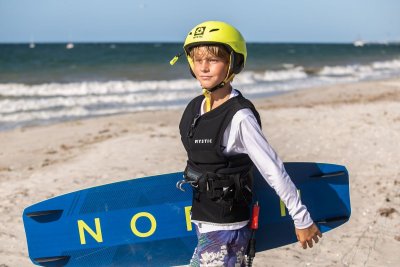
The short answer
Yes, Preá is one of the best places in the world to learn kitesurfing, and it is not just us saying so: it is the instructors who have been coming back every season for fifteen years. A steady side-onshore wind that brings you back to shore, 28 °C water, a sandy bottom without a single rock, a 12 km beach where nobody gets in your way, and low tides that leave the water as flat as a lake. All of it with, on average, 9 to 12 hours of lessons to ride on your own.
In other words: where elsewhere you spend a week waiting for wind or swallowing water in the chop, in Preá you spend a week making progress. Here is everything you need to know before booking your first course.
What makes Preá so easy for beginners
The wind always brings you back to shore. The trade wind comes side-onshore from the right. If you let go of everything, you and the kite drift towards the beach, not out to sea. It is the first thing an instructor looks at on a teaching spot, and the first thing that reassures a beginner.
It is steady, not violent. No gusts, no holes: 18 to 25 knots in the afternoon, every day from June to January. You learn to fly a kite that always does the same thing, and your brain loves that.
Flat water at low tide. Twice a day, the sandbanks emerge and leave large lagoons of 30 to 60 cm of water a few metres from the shore. You can stand, you can see your feet, and you nail your first waterstart without wondering what is underneath.
A 12 km beach. No rocks, no swimmers to avoid, no queue to launch. In Preá, your instructor picks the spot based on you, not on the space available.
28 °C water. No wetsuit, no cramps, no "I'm cold, let's stop". You can stay three hours in the water and think only about your kite.
Instructors who do nothing else. Preá has lived off kitesurfing for twenty years. The schools work with IKO- or VDWS-certified instructors, often multilingual, and with equipment replaced every season.
When to come as a beginner
The season runs from June to February, but for a first course, not all months are equal. A beginner wants reliable wind that is not too strong.
|
Period |
Wind |
For a beginner |
|
June – July |
18–25 knots |
Ideal: wind already steady, not yet too strong, quiet beach |
|
August – October |
22–32 knots |
Possible, but strong wind: you learn with small kites, and the schools are full |
|
November |
20–28 knots |
Very good: wind still constant, fewer people on the water |
|
December – early January |
18–25 knots |
Ideal: gentle, reliable wind, festive atmosphere |
|
February – May |
8–20 knots |
Not recommended for a course: too many days without wind |
Our advice: July, November or December, in a week when low tide falls in the early afternoon.
How a course unfolds, hour by hour
A beginner course follows roughly the same pattern everywhere in the world. In Preá it just goes faster, because the wind and the water do not waste your time.
- Hours 1 to 2: theory and the trainer kite. On the sand, you learn the wind window, the power zones, the safety rules and the quick release. You fly a small 2 to 3 m² kite: this is where your hands understand that a kite is not pulled, it is steered.
- Hours 3 to 4: the big kite and body-dragging. You move to a real kite (9 to 12 m²), with the instructor next to you in the water. You get towed without a board, first straight, then upwind. In Preá, standing in 28 °C water, this step is almost a game.
- Hours 5 to 7: the waterstart. Board on your feet, you dive the kite through the window to get up. This is the step that frustrates everyone, everywhere. The flat water at low tide halves the number of attempts.
- Hours 8 to 10: your first runs. You hold ten metres, then fifty, then you come back. The instructor follows you from the beach or by jet ski depending on the school.
- Hours 10 to 12: riding upwind and riding alone. You leave and come back to the same spot. You are independent. This is usually the moment students ask to extend their stay.
Lessons take place once the wind is established: one session of 2 to 3 hours a day, no more. Beyond that, fatigue sets you back.
How many hours and how much it costs
Allow 9 to 12 hours of lessons to become independent, i.e. 4 to 5 afternoons. On a 7-night stay, that leaves one or two days to ride on your own with rental gear, which is the best way to lock in what you have learned.
|
Option |
Duration |
Indicative price |
|
Private lesson (1 student, 1 instructor) |
per hour |
R$250 to 350 (about €45 to 60) |
|
Semi-private lesson (2 students) |
per hour per person |
R$180 to 250 (about €30 to 45) |
|
Full beginner course |
10 to 12 h |
R$2,500 to 3,500 (about €450 to 600) |
|
Gear rental after the course |
per day |
R$250 to 350 (about €45 to 60) |
Equipment, helmet, impact vest and insurance are included in the lessons. By comparison, the same course costs 1.5 to 2 times more in Europe, for half as many guaranteed wind days. The trip pays for itself quickly.
Prices observed in 2026, to be confirmed with the schools; ask us for a combined accommodation + course quote.
Choosing your school and instructor in Preá
There are about ten schools on Preá beach. All of them are decent; some are excellent. Five questions to ask before booking:
• Is the instructor certified (IKO or VDWS) and does he or she speak your language? A waterstart is hard to explain with gestures.
• How many students per instructor? One or two, no more. With three, you spend half the time watching.
• Is there a radio in the helmet? It has become the norm in good schools: the instructor talks to you while you ride, and you progress twice as fast.
• How old is the equipment? A kite older than two seasons reacts badly and makes you doubt yourself for no reason.
• How do they handle days without wind? Good schools carry the hours over or refund them, no argument.
Classic beginner mistakes (and how to avoid them)
Pulling on the bar. Instinct says "I pull, it goes". In kitesurfing, pulling on the bar means grabbing the power and losing control. You push the bar away to calm the kite. Your instructor will repeat it a hundred times; that is normal.
Looking at the kite instead of the horizon. You go where you look. On the waterstart, look ahead, not up.
Wanting to get up too fast. Body-dragging bores everyone, and yet it is what teaches you to recover your board when you have lost it in the middle of the water. Do not skip this step.
Doing three hours on day one. Two hours are enough. Fatigue builds bad reflexes, and the Ceará sun does not forgive heatstroke.
Forgetting the sun. Long-sleeved rash guard, SPF 50 on the face and hands, a cap under the helmet if you like. One sunburn on day one, and the course is over.
Renting on your own too early. After 10 hours, you can ride in easy conditions. For your first solo sessions, choose a day of moderate wind and a low tide, and stay within sight of a school.
What to pack
For a first course, travel light: the school provides the kite, board, harness, helmet and vest.
• Two long-sleeved UV rash guards (one dries while you wear the other)
• Boardshorts or a swimsuit that stays put under a harness
• Water-resistant SPF 50 sunscreen, plus a stick for the face
• Sunglasses with a strap, for mornings on the beach
• Thin neoprene booties: useless in the water, handy on the burning sand at 2 pm
• A water bottle: you will drink two litres per session without noticing
• If you wear glasses: daily contact lenses, or a prescription mask
If you already own a harness that fits you, bring it: it is the only piece where personal comfort really matters.
Frequently asked questions
Do I need to be athletic? No. Kitesurfing requires coordination, not strength: the kite pulls, not your arms. Students from 12 to 70 learn in Preá every season.
Do I need to know how to swim? Yes, being comfortable in the water is essential, even though you will often be able to stand and will always wear a vest.
From what age? Generally 12 years and 40 kg, with a private lesson. Below that, schools offer kite flying on the sand.
Is it dangerous? Like any board sport, kitesurfing has its risks, but 90% of accidents come from a poorly secured kite or an unassisted launch. With an instructor, a quick release and a spot like Preá where the wind brings you back to shore, the risk is very low.
Can I come with someone who does not kite? Yes, and it is even the most common set-up: lessons can be taken in the afternoon, mornings are free for the spa, the pool or the lagoons, and Jericoacoara is 15 km away for the evenings.
Preá or Cumbuco to learn? Cumbuco is closer to Fortaleza (30 min) but busier and windier. Preá requires a 4-hour drive and offers in return a 12 km beach that is almost empty. For a first course, space makes all the difference.
Ready for your first run?
Our single-storey villas open directly onto Preá beach. Tell us your dates and we will book your instructor, schedule your lessons around the tides and arrange your transfer from Fortaleza.
Discover our "First kite course" stay
Last updated: November 2026. Prices and conditions are indicative.